


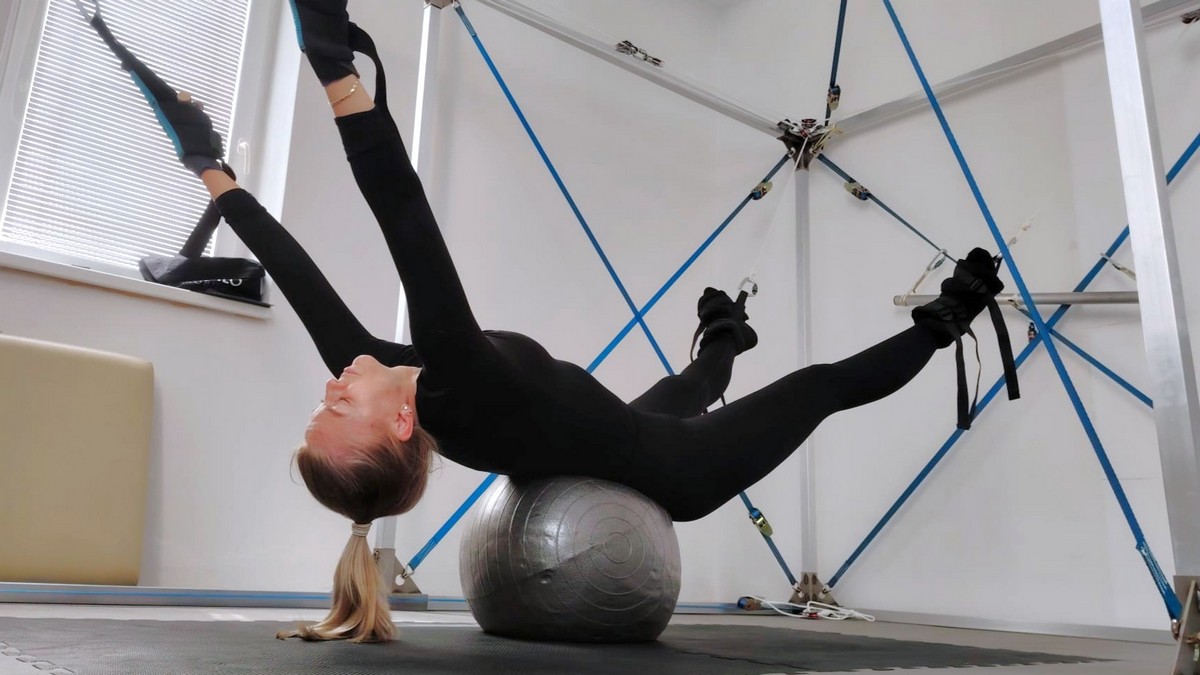
Experienced massage therapist Petr Kašpar from northern Bohemia uses Pravilo Mobilo in his practice. We asked him for a short interview.
Petr, you're an experienced massage therapist and trainer. What led you to incorporate Pravilo Mobilo into your practice?
As a massage therapist and trainer who has been working with people for many years, I was always looking for a method that could help clients faster, more effectively, and most importantly, in the long term. In practice, I saw that many problems — back pain, stiff muscles, limited mobility — don't arise just from weakness, but also from shortened fascia, dysfunctional movement patterns, and overloading of deep structures. That's exactly why Pravilo appealed to me. It allows you to work with fascia and deep muscles that regular massage can't reach. It can release the body within a range that the client can't create themselves. It connects strength, mobility, and breath into a single functional whole. The results are fast, noticeable, and stable.
Do you remember your first moment on this device? What were your immediate feelings after the exercise?
Right after the first session, I felt something I had never experienced before. It was a combination of euphoria, deep relaxation, and the sensation of a completely different body. As if parts that had been stiff or blocked for years had suddenly opened up. Movement was easier, breathing freer, and the whole body felt more elastic. The contrast between the tension before the exercise and the release after was so striking that I knew immediately this was a method with enormous potential — not only for me, but for my clients as well.
Can Pravilo replace certain manual therapy techniques, or do you see it more as an ideal complement to massage and therapy?
Every method has its place. I don't like the "method A is better than method B" approach. Every technique has its function, its purpose, and its justification. It depends on what, when, and with whom we're using it. Context is always key. That's why Pravilo isn't here to replace anything. I see it as an excellent complement to both massage and therapy. It allows you to work with the body in a different way, at different angles, and within different ranges than you can achieve with your hands. And most importantly: it's not about "using Pravilo," but about knowing how to use it. Only the combination of proper technique, timing, and an understanding of the client's body gives the whole method its true meaning.
Many massage therapists suffer from back or hand pain due to the physical demands of the work. Does Pravilo Mobilo help you directly as a therapist in this regard?
Absolutely. My fingers and elbows used to be chronically overloaded for years — it's common among most massage therapists because the work is physically demanding and one-sided. Since I've had Pravilo in my practice, I honestly don't even know what elbow pain is anymore. After work, I just hang by my fingers for a few minutes and let my hands loosen up. For me, it's the ideal way to release my forearms, shoulders, and thoracic spine after a long day. Of course, I also use Pravilo for targeted training of muscles, ligaments, and tendons, which is what it was primarily designed for.
There's an endless variety of training protocols — for children, women, seniors, but also specific strength training for men that can push you beyond the limits of your psychophysical capacity. For me, as a massage therapist and personal trainer, it's a tool that not only helps my clients, but also protects my own body so it can keep functioning long-term without pain.
What types of problems do you most often recommend Pravilo for to your clients?
There's no simple answer to that. It doesn't matter whether it's an office worker, a professional driver, a carpenter, or a professional athlete. Pravilo doesn't work with just one muscle group — it works with the entire movement chain. And when you work with the whole chain, you automatically work comprehensively with the whole person: their posture, breath, mobility, fascia, strength, and tension. That's why it doesn't matter "who" comes in — what matters is what their problem is and the context in which it arose.
The device allows training with body weight, but also with a counterweight system. How do you use these two forms in practice?
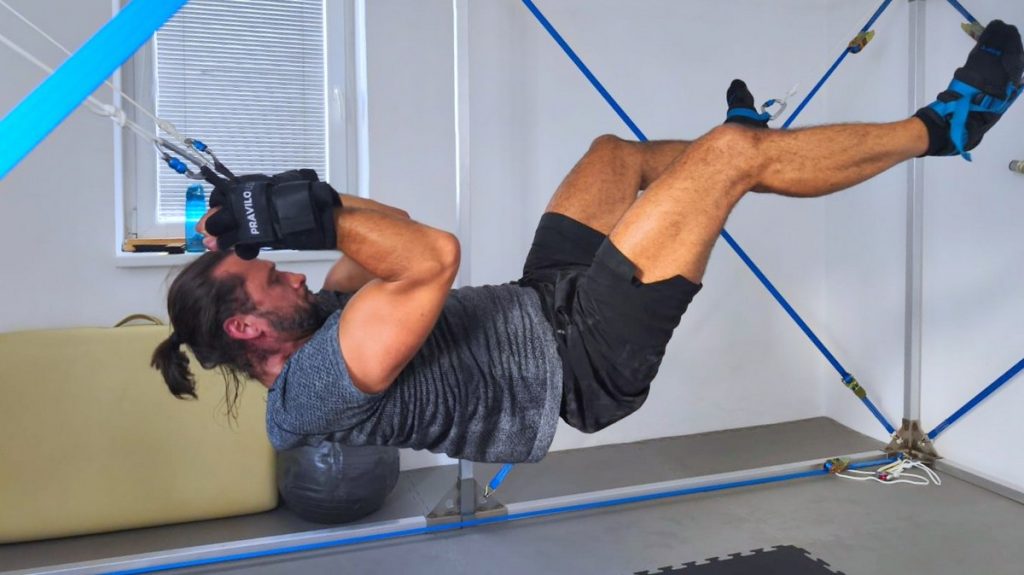
I use bodyweight training with everyone — men, women, and children. It's a safe, natural way to work with mobility, fascia, stability, and overall body release. Free weights, on the other hand, are exclusively for men. This is the original, traditional form of Pravilo — no winches, no aids, just pure work with the body and the counterweight.
And this is where the Ferrari and heavy off-road comparison fits perfectly. Bodyweight training is like a Ferrari: elegant, smooth, pleasant, and suitable for anyone who wants to improve mobility and release the body. But as soon as the "terrain" comes — when real strength, endurance, deep fascia work, and psychophysical capacity are needed — you reach for the off-road. In this traditional form, a minimum of 50% of body weight is used on each limb. A man weighing 100 kg therefore has 50 kg on each limb, 200 kg in total. And that's just the very beginning. This form of training has a completely different intensity, dynamic, and effect.
And why is this more demanding training specifically for men? Because the male body is evolutionarily built for greater strength loads, higher endurance, and the ability to work with intense stress. Men have a different hormonal response, a different muscle mass ratio, and a different way the body reacts to extreme loads. That's precisely why free weights develop testosterone, growth hormone, strength, stability, and psychophysical resilience in men in a way that would be unnecessarily harsh and ineffective for the female body.
Do you have professional athletes among your clientele? What is their most common feedback after the first therapy sessions on Pravilo?
Yes, I have professional athletes too. And their reaction is practically the same as mine was the first time. Surprise at how deeply and intensively Pravilo can work, and at the same time, a relief they don't feel with conventional methods.
Petr, athletes often struggle with overload and muscle fatigue. How specifically does Pravilo Mobilo help speed up recovery after intensive training?
With athletes, it's most often about overload, fatigue, and accumulated tension in both muscles and fascia. Pravilo has a major advantage here because it doesn't work with the body piece by piece, but addresses entire muscle-fascial chains at once. As a result, the body releases comprehensively, not just locally, and the athlete doesn't have to gradually stretch one area after another. Pravilo takes the whole body at once. And honestly, athletes already have so much training behind them that the prospect of another long compensation routine isn't very appealing. Pravilo allows them to do a lot of work in a very short time. Recovery is faster, fatigue fades significantly sooner, and after a few minutes the body feels lighter, more elastic, and freer. Pravilo can shorten the time needed to return to full performance and helps athletes maintain better balance in the body even under high loads.
Many sports involve one-sided loading (hockey, tennis, golf). How do you think Pravilo can compensate for these muscular imbalances and prevent injuries?
Pravilo is literally made for compensating one-sided loads. But there's one important thing to watch out for: using Pravilo only as a release tool would be a mistake. In these sports, imbalances arise where some muscles are tight because they're overloaded, and others are tight because they're weak. If we only released all of them, we could paradoxically cause more harm. Here we come back again to the most important thing — context. It depends on when, on whom, and for what we use it.
Pravilo can compensate for one-sided loading precisely because it works with entire muscle-fascial chains, not just one spot. But real compensation doesn't come from passive release — it comes from a strength program on Pravilo that activates the weak parts of the chain, releases the overloaded segments, and restores balance between the right and left sides of the body. This strength program is the key to injury prevention. In sports with one-sided loading, it often determines whether the body will handle the season without problems, or whether overload and pain will start to appear. Pravilo can therefore not only compensate, but also protect the athlete's musculoskeletal system in the long term.
What would you say to people who have a natural respect or fear of "suspension" on the ropes?
It's completely normal to have respect. We usually fear what we don't know. And that's exactly why I say: come and get to know it. When a person finds out how safely they're secured, how the rope guides them, and how the body reacts, that fear dissolves within seconds. Most people tell me after their first suspension that it was much more pleasant and natural than they expected. Respect is fine — but don't let it decide for you. Just take the first step; the rest is taken care of by the experience itself.
Where can people interested in training under your guidance find you?
I work in northern Bohemia, in Jablonec nad Nisou. You can find information about me and contact details here: